After breakfast we were off to our next island, Isla Plaza. A quick(?) 45 minute bus ride took us back to the Ferry (we soon learned that all trips started at the ferry so we had several more of these bus rides to go). We boarded a boat for a 1-1/2 hour ride to the island.
When we arrived we found that there were actually two islands: Isla Plaza North and Isla Plaza South. We toured the southern island.
The island is a long fairly narrow strip of land with only prickly pear cactus, scrub bush, and a red colored plant called Sesuvium for covering. It has a gentle slope upward towards the middle of the island. But beware. Once you get to the top you find that the whole backside of the island has been chopped off with a several hundred foot drop all along it.

Our arrival was also met with a colony of about 20 Sea Wolves (they look like sea lions but are sturdier) swimming and barking at each other. We even had to step around one on the pier to get onto the island. We toured this rocky island for about 2 hours with our guide talking about the Sea Wolves, the marine and land iguanas, and lava lizards. We also saw large flocks of Red-billed tropic birds and swallow-tailed gulls flying and nesting on the cliffs. Oh yeah, I forgot to tell you that it was very hot with minimal breeze. Since we are practically on the Equator we had direct sun all day long. We used a lot of sunscreen and drank plenty of water.


On the way back Paul had the opportunity to go snorkeling. He spent about 30 minutes in the water where he saw a multitude of different tropical fish and a white-tipped shark!

It was then a 1-1/2 hour boat ride back to the Ferry and another 45 minutes ride back to the hotel. Meanwhile at our hotel, one of the sea lions took over a deck chair for it’s siesta.

Since we arrived back at the hotel in the afternoon, we had a chance to explore the village. One interesting stop was the local fish market where fishmongers sell to the locals. A flock of pelicans and a sea lion were on hand to catch any pieces of fish that were discarded as the fish were cut and sold.

The next morning we awoke in the city of Quayaquil, Ecuador. We didn’t spend any time there as we were off to the airport for our flight to the Galápagos Islands, Ecuador. Our flight was 1-1/2 hours and we landed at Seymour Airport on Baltra Island. Other than the airport, there’s nothing on the island. The airport was used by the U.S. military during WWII but left after the end of the war. Concrete pads, and dirt roads are pretty much all that’s left. We took a local bus from the airport to the ferry landing and crossed to Santa Cruz Island where our hotel was located.

It was a 45 minute drive from the Ferry to our hotel but we made one stop along the way to see the famous Giant Galapagos turtles! By law, the turtles are free to roam anywhere they want on the island. It was strange to see them in such a forested/green region on the island. Apparently they roam the island eating as they go and only return to the beach for mating and laying eggs. We also saw a pretty yellow warbler.


After viewing the turtles, we took a small tour thru an old lava tunnel. The Galápagos Islands were all created by volcanism. These are not the explosive types of volcanos, rather, the lava flows from these volcanoes in a more gentle fashion. These tunnels were created by the flow of lava to the surface. It’s eerie walking thru one of these lava tunnels. These days they’re also home to bats. You can definitely smell them as you walk.


We made our way on to our hotel, Red Mangrove, in the city of Puerto Ayora. This is a typical tourist type of town with alternating restaurants, bars, and hotels along the beach front.
We were greeted at the hotel with bark of a sea lion on the wharf at the back of the hotel and a dozen Iguanas sleeping on the back deck. A great but tiring day.

Two days after exiting the Panama Canal, we arrived in Ecuador at the city of Manta.
Manta is the largest seaport in Ecuador. It’s main industries are fishing (primarily tuna) an tuna canning. It was fun to watch the ships next to us unloading the tuna. A lot of this tuna is shipped to the U.S. market. I never realized just how big they are! Our ship bought two of them. Guess what was on the menu that night!

We left the ship for the day on tour where we visited the local cultural museum. It was small but well done. They had a replica of a typical mountain hut and scenes of coastal living.
We left the museum to visit an Agave fiber factory. Agave is the plant used to make tequila. The main body of the plant is used to make the tequila while the leaves are used to make Agave fiber. The leaves are scraped to remove the fleshy pulp leaving behind the Agave fiber. The fiber is dried and then combed to make it pliable. The fiber is then spun into a coarse thread which is used to make Agave fiber products.

One of my favorite stops was where they use the Tagua nut to make buttons. Tagua is also known as vegetable ivory and was a well-kept secret by British shirt makers. The various stages from the nut to the button were shown. Carvers can make all sorts of interesting items as well.

Our final stop was at the Panama hat exhibition. Contrary to their name, Panama hats are actually made in Ecuador. They got the name because of the workers on the Panama Canal bought a lot of the hats and when they returned home when people asked where they could buy one they told them “Panama”. So the name stuck.

We are making our way down the west coast of South America to our next port of call in Ecuador. Manta is the port. The next day we land at Guayaquil where we leave the ship for a six-day excursion to the Galápagos Islands and then Machu Picchu. Today on ship we are attending lectures to learn about Manta, the Incas, attending cooking demonstrations by a guest chef from Costa Rica, and watercolor class.
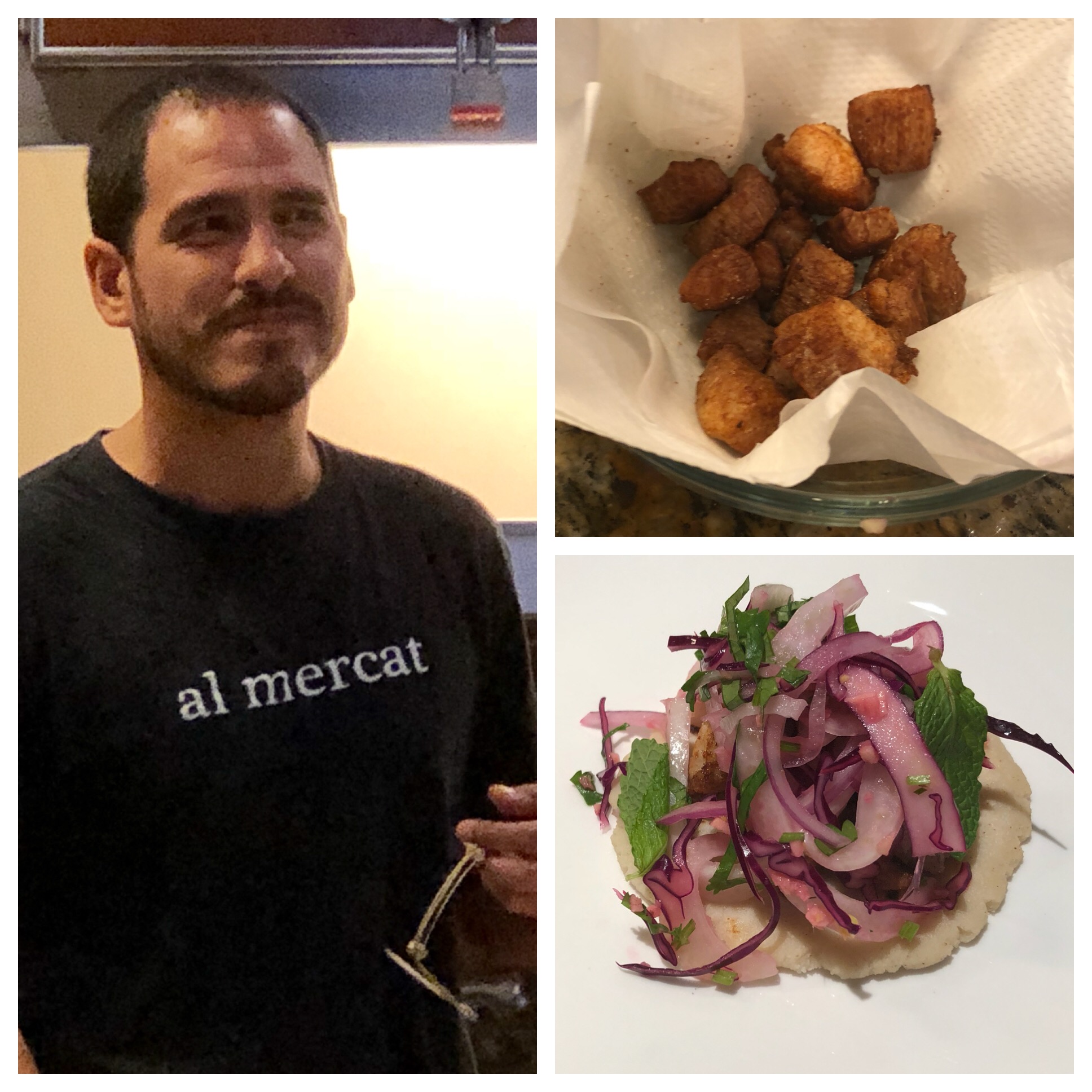
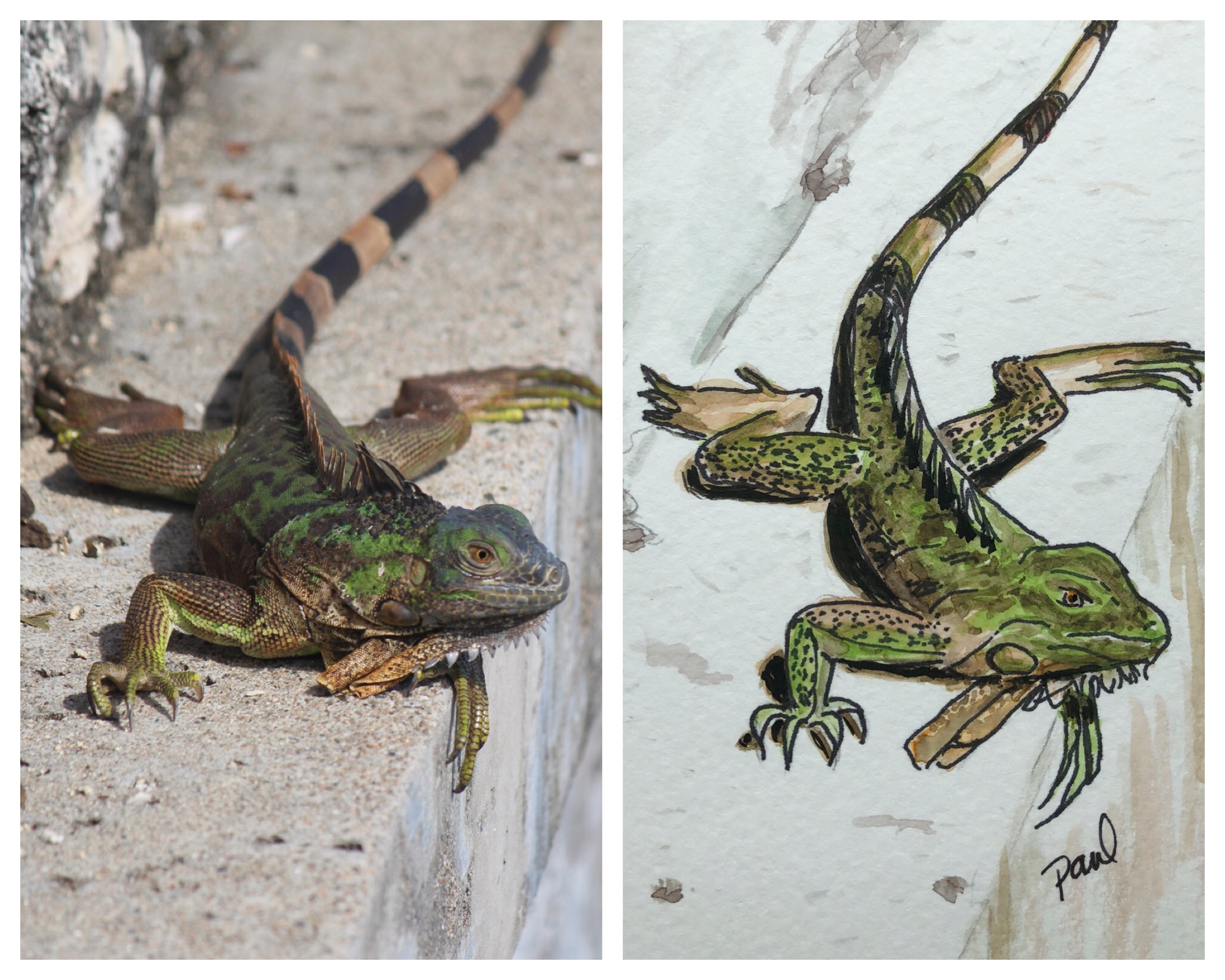
The guest chef is Jose Pablo Gonzalez who was a lawyer, turned chef. He studied in Paris and brought what he learned back to Costa Rica to develop dishes based on those he grew up with. He is a big proponent of using the rich variety of foods grown in Costa Rica. Above he made tortillas, topped with chicharrones and a slaw salad of fennel and red onions. I sketched Ron’s photo of a green iguana and painted it during watercolor class. The lesson was to use lots of layers of paint and build up the color. I’m still experimenting with how much ink to use in addition to the watercolor.
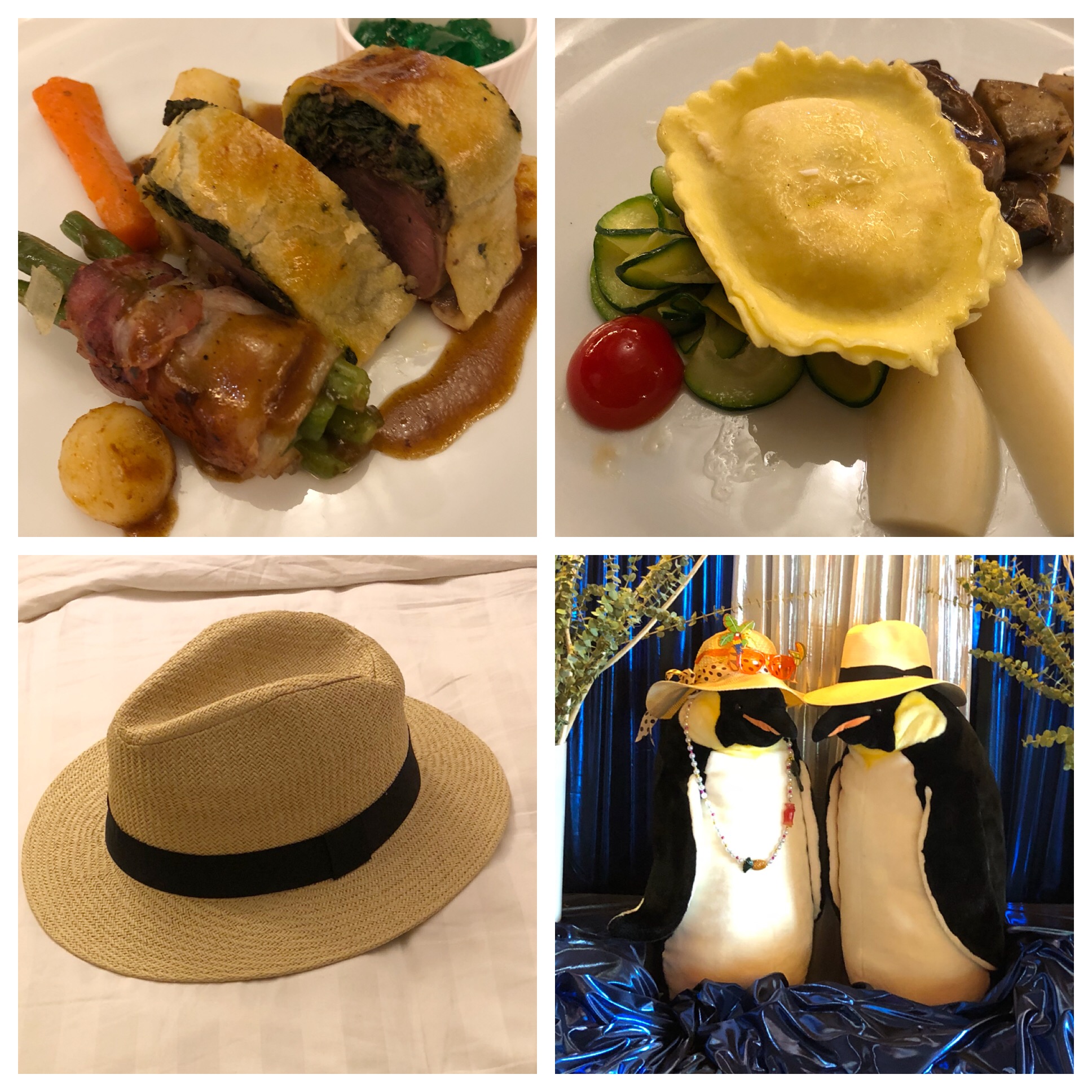
Tonight was another Gala Night, so we dressed up in our suits. But it was also Panama Hat night. We were each given a Panama hat at dinner (both of ours were too large). Panama hats are actually made in Ecuador and popular with the men who worked on the Panama Canal… thus the name. It is said that a real Panama hat can be rolled up, passed through your wedding ring, and then unwound again. The hat was popularized by FDR when he visited Panama. In front of the dining room, the penguins showed up again wearing Panama hats! The dinners were amazing… Ron had lamb and I had filet mignon with a lobster ravioli.
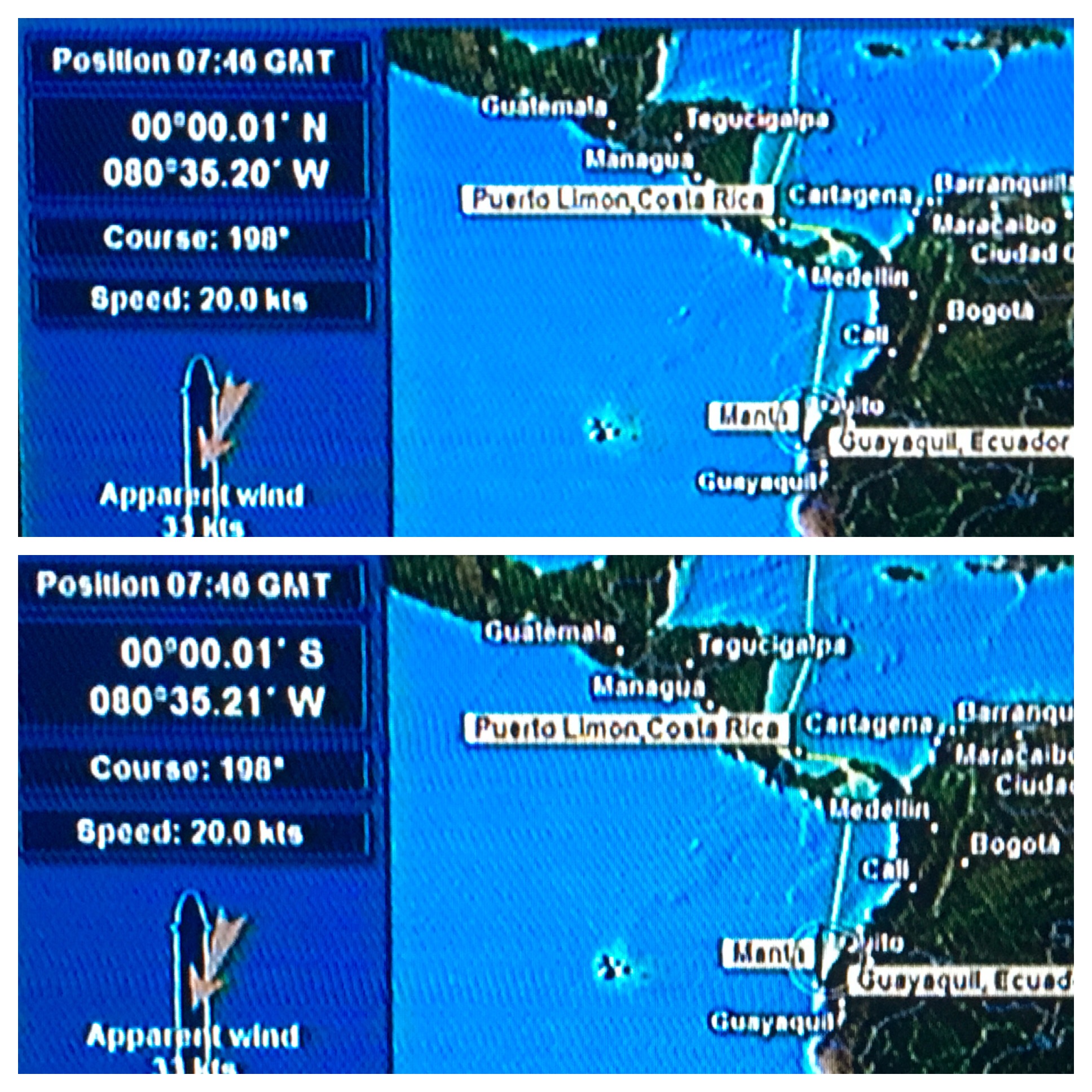
During the night, we actually crossed the equator. If you look carefully, you can see the transition from 1 minute North to 1 minute South.
We arrived at the Panama Canal at about dawn today. Since we did this passage last year, we did not jump out of bed in the dark to watch the approach. However, the call of the “Panama Rolls” and coffee DID get me dressed and on deck early. They only serve these treats until 9:00 a.m. and only in certain areas of the ship. I went out to the bow of the ship to watch our approach to the first lock of three that ultimately raises the ship from sea level to about 90 feet above sea level where we enter a huge man made lake to cross toward the Pacific Ocean.


Even though we are a relatively small ship in length, we still are wide enough that there are only a few feet between us and the wall of the canal. At the exit end of the canal, when we pass through three more locks that lower the ship back to sea level, the view from our cabin window changes from the buildings surrounding the canal to the walls of the canal. This is pretty cool to watch since it only takes about eight minutes to raise or lower the ship in the lock.

During the day-long trip from one set of locks to the other, Ron was able to photograph a pelican and some sort of eagle-like bird. One thing I found very interesting is that a huge suspension bridge is being built (top right-hand photo) that will allow auto traffic to cross the canal. Currently, the automobiles and trucks must pass directly in front of the canal gate on a road that folds away when the gate is open (see third picture down on the left). Cars can get stuck waiting to pass for 20-30 minutes at a time!