


Day 104 of 111. Funchal, Madeira
Our final foreign port on this Grand World Voyage is the city of Funchal on the island of Madeira. Our excursion first took us to the highest cliff in Europe (and the second highest in the world), Cabo Girao. Of course, they have built a glass-bottom vista point at the top of the cliff which gave a beautiful view of the city of Funchal 560 meters below and allowed us to see some of the terraces that have been built all over the island to allow farming of bananas, sugar cane, and wine grapes. (Madeira wine is famous and was what Ben Franklin, George Washington and Thomas Jefferson toasted with after the signing of the Declaration of Independence). We also saw a beautiful lavender-blue flower called the “Pride of Madeira”.
On the trip back to town, we saw more of the terraced hillsides (all terraced and worked by hand) and stopped at a spot where Winston Churchill painted a picture of the boats, water, and cliffs of the Camara fishing village. You can tell from my photo that the town has not changed too much since 1950.

The end of the tour included tea at the famous Reid’s Palace Hotel. This hotel is owned and run by the people who run The Orient Express. The hotel was elegant and we would not have been too surprised to find Agatha Christie’s Belgian detective, Hercule Poirot wandering around the grounds. If you look in the upper right corner of the four of us at the tea table, you can just see our ship, ms Amsterdam, in the harbor.
The tour was great, but we had to wear nice clothes, slacks and dress shoes to visit the hotel. We were dropped off at the ship, we changed clothes and went back out to the town to explore. This is the last land we will see for seven days.


We went to a little park in the city next to the water. It is spring and many different types of flowers are blooming. Funchal has been voted one of the best tourist destinations and they pride themselves on their flowers, native and imported. We saw some beautiful examples in the hotel gardens, but more in the park with a pond inhabited by swans, ducks, and fish. The streets had mosaic pictures embedded along the avenues. We really liked this one of a ship. We worked our way through the town to the open market, but my eye was caught by a bakery with homemade chicken and mushroom pie (only seven euros). At the market, we found several fruit sellers, some souvenir shops and a huge fish market that was just finishing business for the day. We stopped at a cafe for some snacks, some drinks, and some good internet. It was a restful break and then we started back for the ship.

The local cathedral, designed in the late Gothic style and dating back to 1500 A.D. was our last stop. The gold and detail inside was very impressive. I said a little prayer asking for safe travels and we returned to the ship.
Day 102 of 111. Rabat, Morocco
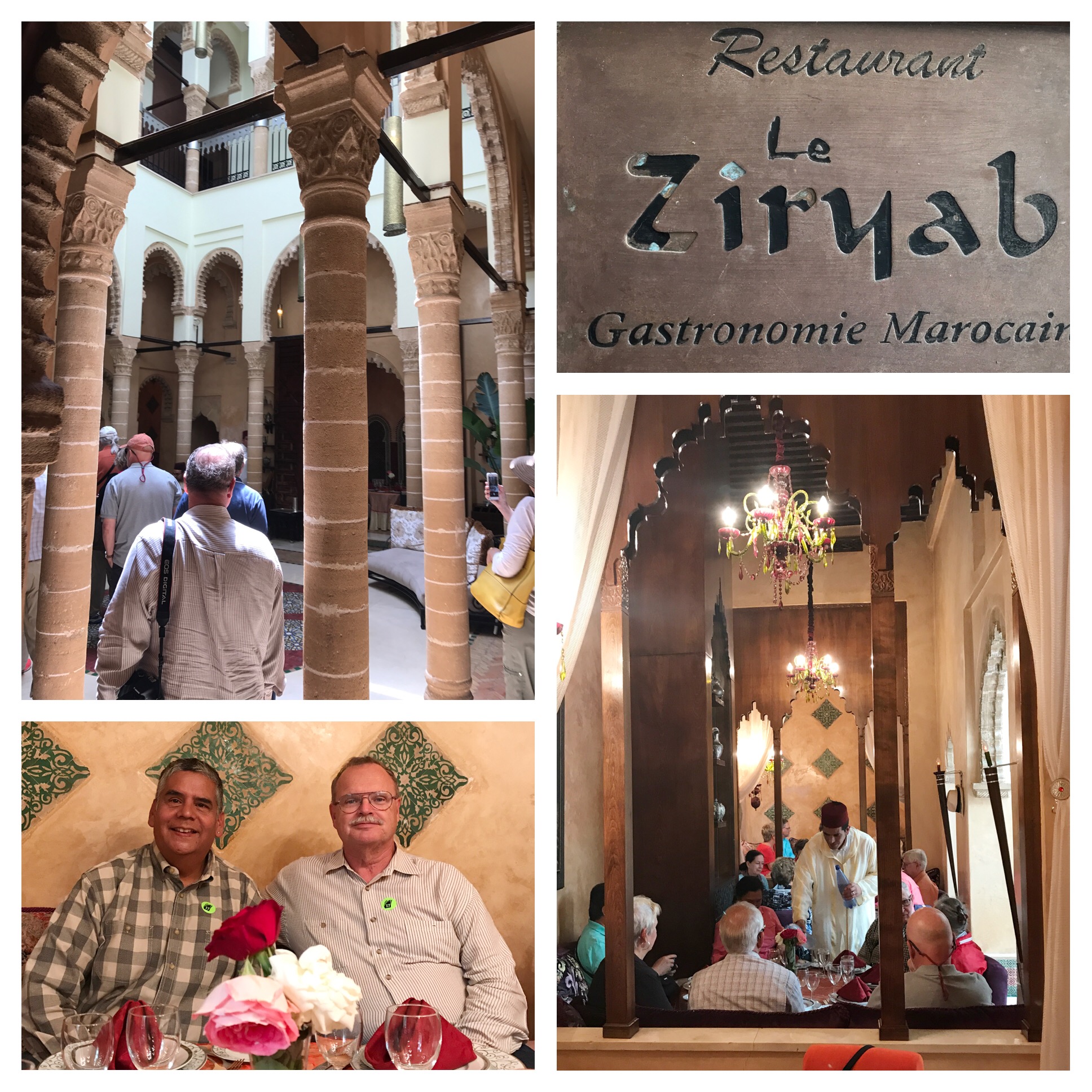
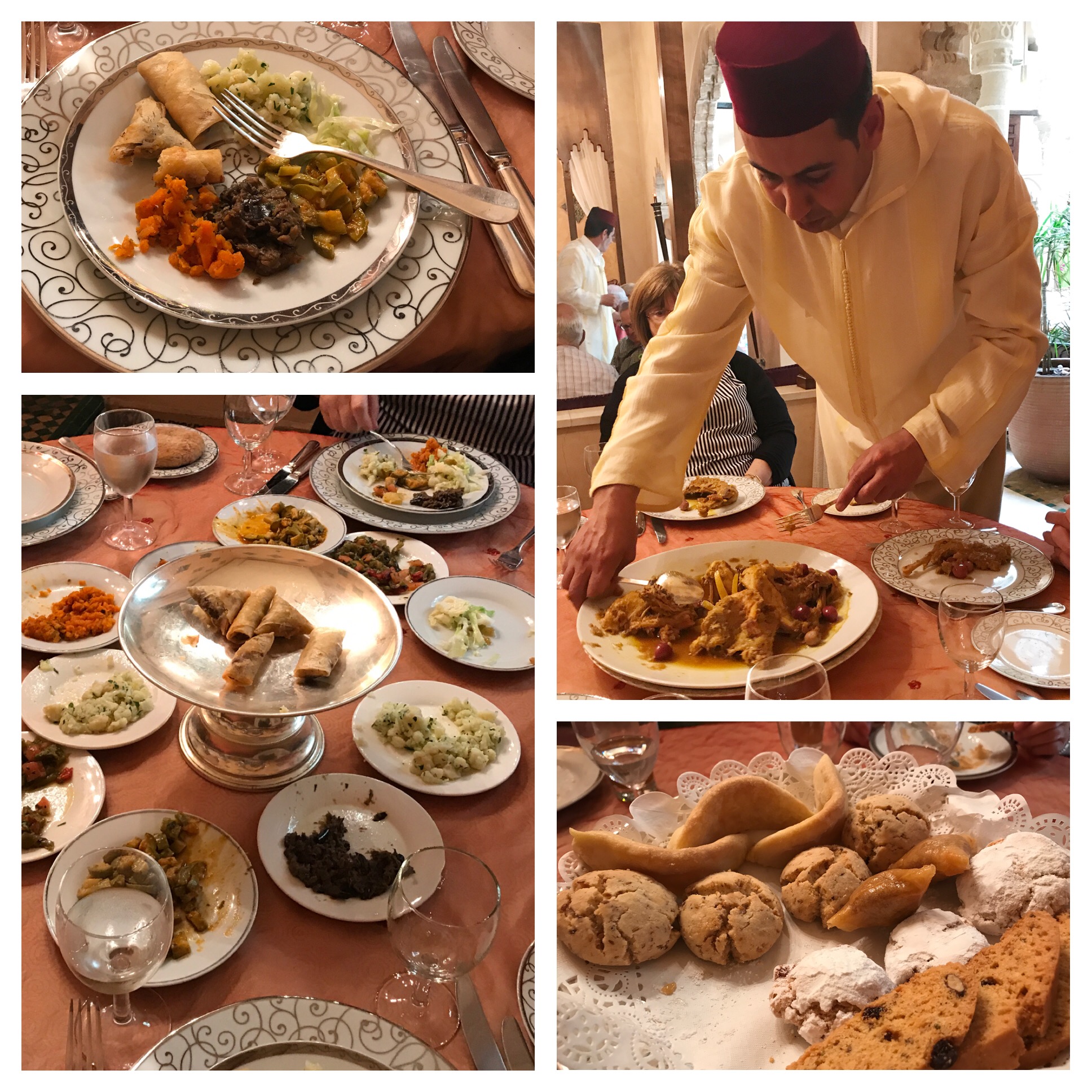
After we finished our tour of Casablanca, we traveled further up the coast to Rabat, the capital city of Morocco. After visited the royal compound, we went to a Moroccan restaurant for lunch called Le Ziryab. When the waiter brought us water, he asked “Distilled” or “Gas”? That kind of threw us for a loop until we figured out that the choice was “bottled” or “sparkling” water. We were brought small plates of foods such as cauliflower, carrots, eggplant, cabbage, and courgette. Each dish was spiced or pickled or some other process that made it delicious. We also had little rolls filled with chicken, fish, or vegetables. The main course was brought in a large silver tangine (a cone shaped cooking vessel) with chicken and pink olives. Ron and I tried the olives again and we have still not changed our opinion of their flavor. For dessert we had a puff pastry with vanilla cream (not shown) and then tea in a glass with an assortment of delicious pastries. Some were like long empanadas filled with almond paste, some were like dry cookies flavored with cardamom, some were a little like baklava and some were like biscotti. All were delicious, especially with the tea. It was a wonderful meal, but we were glad to get up and do some walking afterwards.
A visit to the Kasbah of the Udayas, Rabat, Morocco
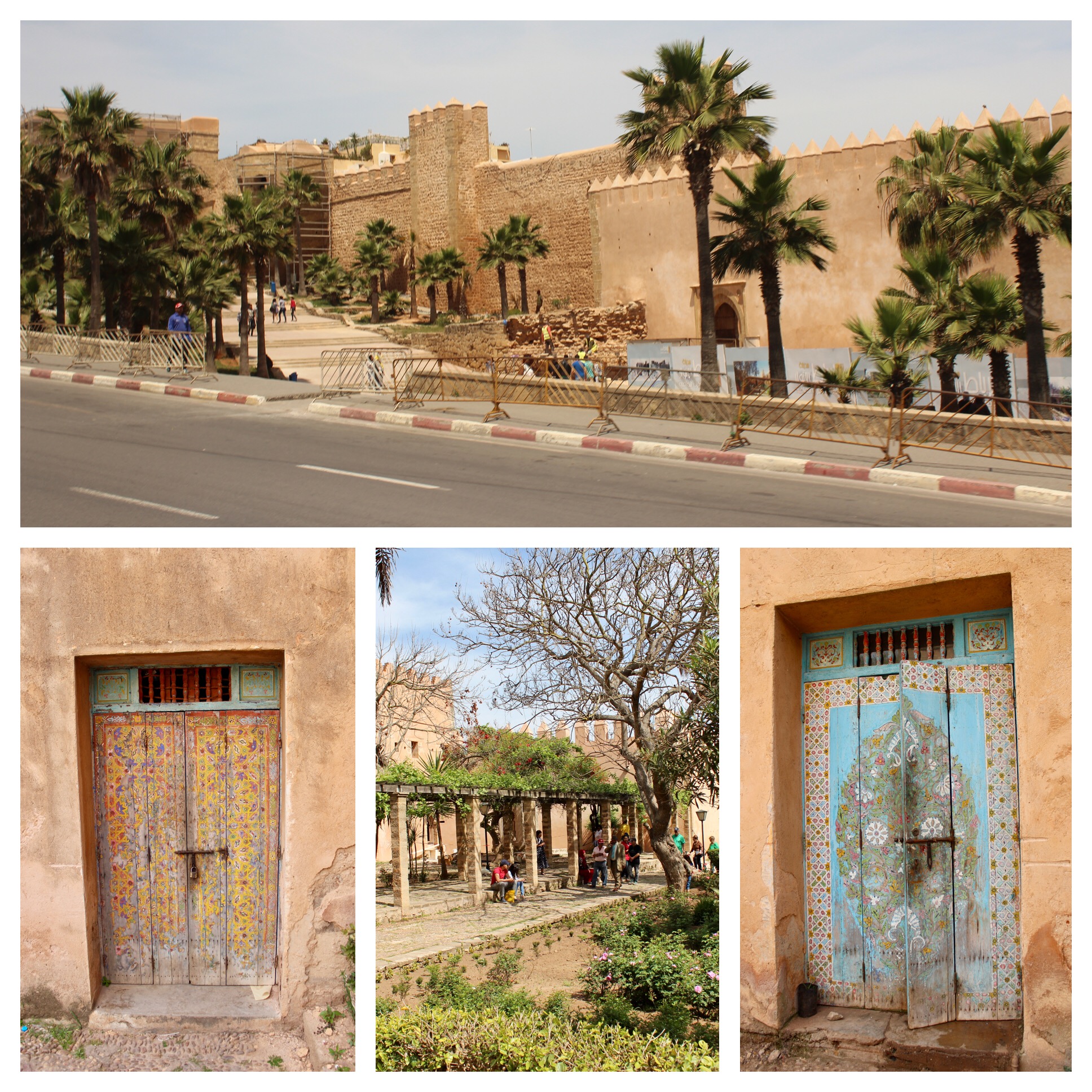
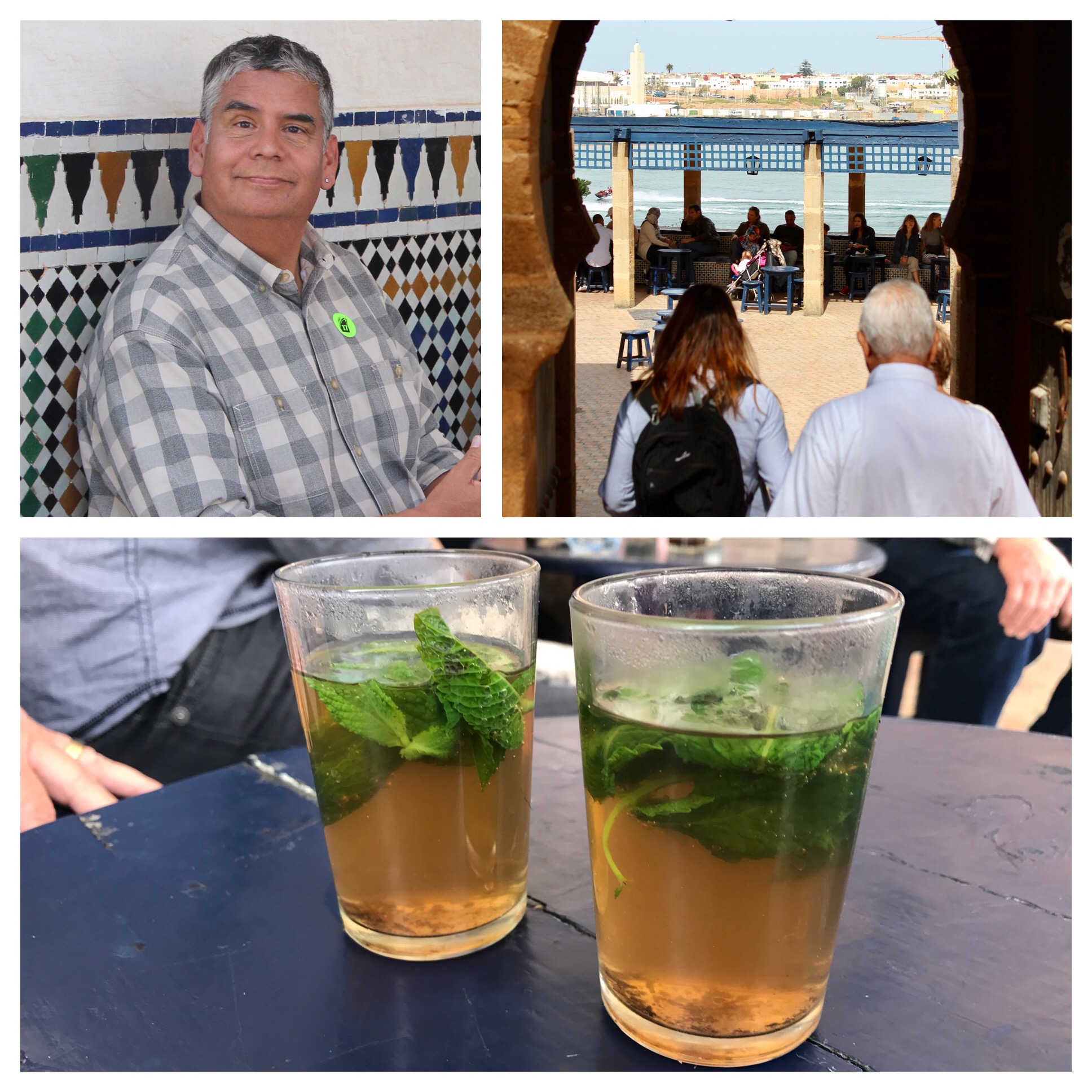
On the Bou Regreg River, there are places for recreational boating, some beaches, and a kasbah. Walking into the area we found women along the street holding syringes ready to do henna tattoos. Inside the city walls we passed a gate into the Jardin Andalou and found some very nicely painted doors. We sat in a cafe and were served mint tea with a little sugar. I kind of expected iced tea, but the tea was hot but still refreshing.
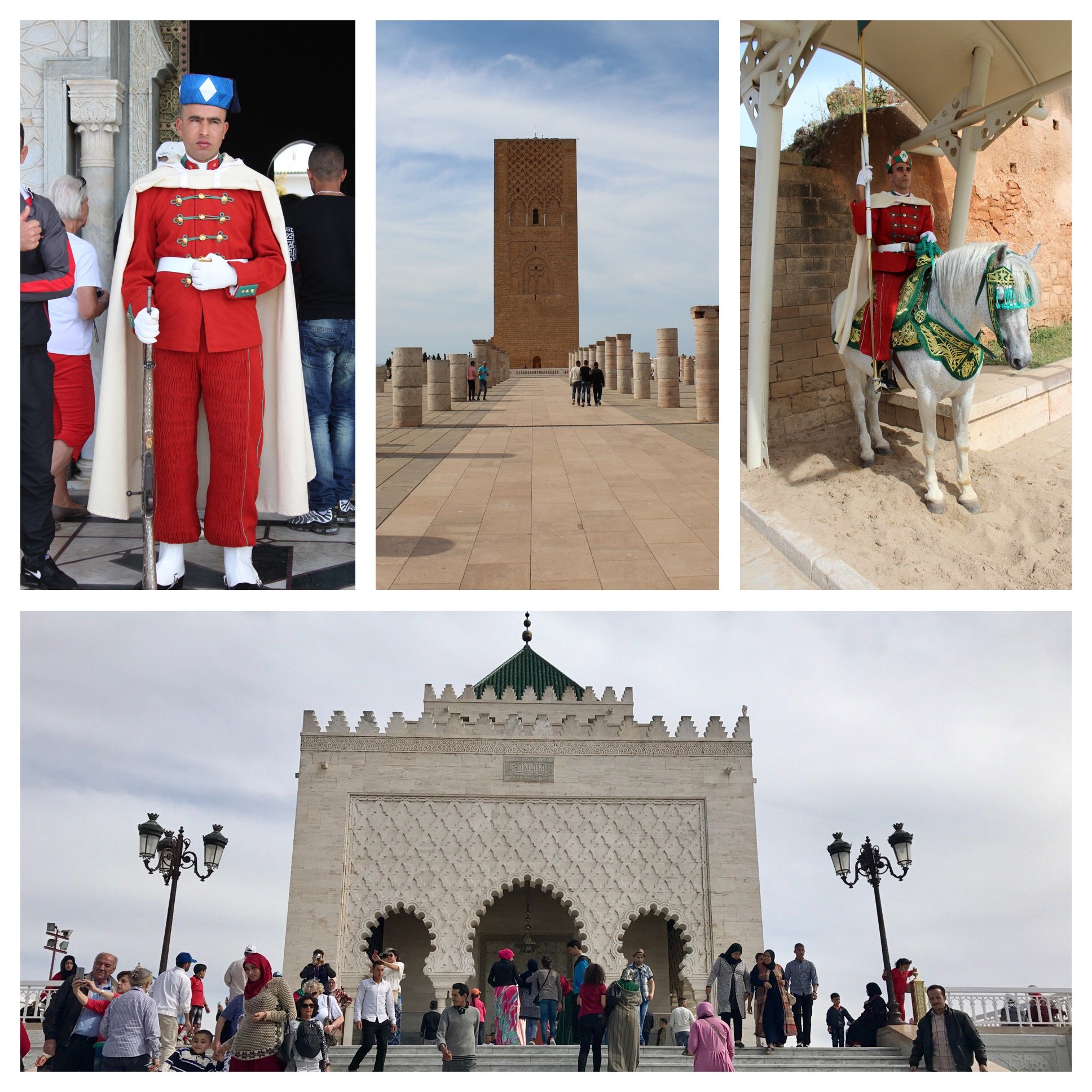
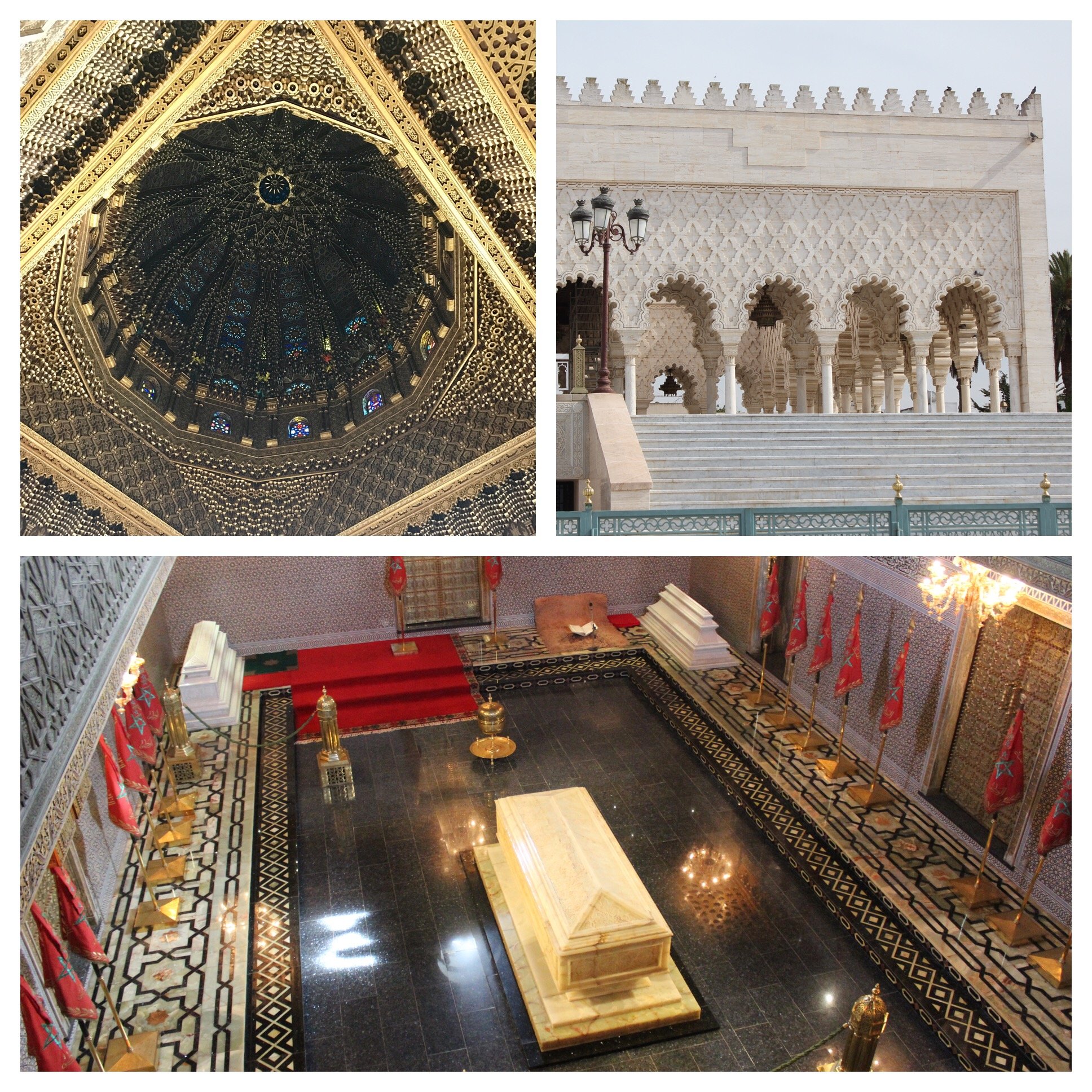
Mausoleum of King Mohammed V, Rabat, Morocco
Soon after our refreshing tea, we departed the kasbah to the Mausoleum of King Mohammed V. The mausoleum was built by his grandson, the current king, Mohammed VI on the site of a huge ancient mosque that was destroyed by a great earthquake in 1755. The large tower on the site was never completed, but remnants of the original walls remain and stacked cylinders of granite represent the columns from the original mosque. Entrances to the mausoleum complex are flanked by royal guards on horseback and the mausoleum itself has guards standing at attention outside and inside the building.
The mausoleum contains the remains of Mohammed V (in the large central crypt) and King Hassan II (the current king’s father) and Prince Abdallah (King Hassan II’s brother) in the corners of the mausoleum. Next to the smaller crypt in the corner is a chair where a cleric reads/recites verses from the Koran. Looking up above the crypt area, the dome is just as spectacular to view. In addition, the complex also contains a mosque and a library that looks similar to the mausoleum in materials and style. Soon after our visit we returned to our ship in Casablanca.


Day 102 of 111. Casablanca, Morocco
There is a region in the older part of the city called the Habous Quarter, kind of a marketplace or city center. We walked through some small streets lined with carpet sellers, a few souvenir shops, and cafes. We visited a very fascinating small cul de sac with about ten different olive vendors. There were olives of many different varieties and processed different ways. Some had spices and some were mixed with chilis. Tubs of chili paste and preserved lemons were also available. Neither Ron nor I like olives, but it was still a great visit. We tasted some cornichons that were delicious, however.

Day 102 of 111. Casablanca, Morocco
Of course, the first place that comes to mind when you say Casablanca is Rick’s Cafe from the movie, Casablanca. Rick’s Cafe is fictional, but there IS a cafe built especially for tourists. I can see now the strategic importance of Casablanca. The city is on the continent of Africa, but just on the sea coast below Spain and Portugal in the Atlantic Ocean. My eye was also caught by the stop sign written in Arabic.


The Hassan II Mosque, Casablanca
Our tour included a short photo stop at this huge Mosque. It is the third largest in the world and can hold thousands of people inside and even more in the courtyard outside. Unfortunately, we did not stay to see the inside of the mosque which was reportedly incredible, and judging from the outside, I can believe it. As we approached the huge minaret, it did not seem to get any closer. I wish my picture could convey the feeling of awe that this building inspires.

We had the opportunity to visit the royal palace of King Mohammed VI. The palace is where official business is accomplished. The King has a royal palace and a royal residence in several cities in Morocco. King Mohammed VI is a young king and a very popular successor to his father (King Mohammed V) who molded this country and instilled a culture of religious tolerance. The King’s wife is also popular and has been given the title of Princess since, unlike traditional wives, she is active in good works for her country. The architecture of the palace doors as well as the materials used were impressive and interesting to see. The doors on the Guest Entrance (upper left picture) are made of yellow copper and brass. The pillars on either side are Carrara marble topped with plaster work of fine detail. The roof is cedar and mosaic tiles create interesting patterns. On the streets near the palace the street lights have a distinctive pattern. They looked to me like olive leaves.

Day 101 of 111. Cadiz, Spain
After our overland trip to Madrid, we met the ship in Cadiz on the west coast of Spain in the early afternoon. We had a few hours to explore the town which was within walking distance of the port. We visited Cadiz on Holy Saturday. In this predominantly Catholic country, the days before Easter feature processions, so there were many balconies decorated with deep red cloth banners and several of the city streets contained boxes for seats or at least chairs lining the sidewalks. Looking down the fountain in one of the city squares, we could see the cathedral where the processions began and ended.


As today is the Saturday after Good Friday, the procession here in Cadiz was very short. It began at 3:00 pm and processed on various city streets where it arrived at the cathedral at about 4:00 pm where we saw it. It was lead by a local Naval Cadet band, followed by the “pilgrims” in their multicolored robes as penitents. Next came the huge silver cross. Notice the cross-bearer is barefoot! Then we saw the main float which was a silver and glass casket containing the crucified body of Christ. A couple of the local school girls carried cushions with replicas of the crown of thorns and nails. They were followed by various officials walking in the parade, and finally the float of the Virgin Mary. Notice the feet showing under the float. There were probably 40 people or more carrying the float on their shoulders for the whole time. And did I mention, it was in the mid 80s outside. Who knows how hot it got under the float. Once the procession passed us, it proceeded to enter the Cathedral through the large front doors.